
- 1CICLONADA - RHR feat. Logan_olm
- 2INNA COMBINATION - RHR feat. BIGMAMMAZUKI
- 3PULSAÇÃO - RHR
- 4SÓ ENVOLVIDO - RHR
- 5SYRINX - RHR & Skrillex feat. Me Jesmay, Lucas Swatch
PAN 164
•
Edition of 5
‘GÍRIA’, the name of RHR’s new EP, is more than a word. It’s how language bends under the weight of bodies, histories and sounds that were never meant to fit inside it. Born from the friction between tongues - African, Indigenous, Queer, street, ancestral -, GÍRIA [slang, in brazilian portuguese] is how people translate themselves into existence.
GÍRIA is also a way of subverting language, of hiding meanings, of creating shared codes among those who know how to read them. It’s a form of encryption born from community and experience, a system of signs that only becomes legible through collective knowledge. To speak in GÍRIA is to reclaim power over meaning, to make the language dance to another rhythm. It loops, mutates, comes back altered yet somehow the same. Like a capoeira circle or a spiritual gira, it’s a collective motion.
“I chose this name because GÍRIA is fundamentally about creating meaning. It’s about reshaping language and giving new significance to words, in the same way we seek meaning in life, in symbols and in the experiences we return to again and again” says RHR, Brazilian DJ and producer from Diadema, São Paulo.
GÍRIA also echoes another Brazilian portuguese word: girar [to spin]. The entire concept of the EP revolves around movement: circular motion, spiraling energy, the idea of returning to the same point transformed. “My music has always been influenced by capoeira and Brazilian percussive traditions, which carry this physical and rhythmic sense of rotation
and continuous flow.”
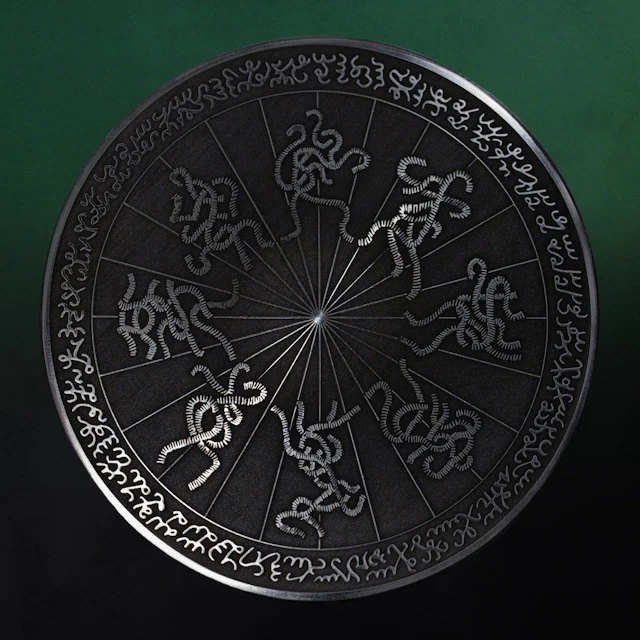
This idea also extends to the project’s visual identity, developed by CAVALO-CAVALO: the symbolic alphabet, created in collaboration with the artist Waldomiro Mugrelise for the EP cover, functions like a secret language, one that must be decoded to be understood. From this foundation, the idea of the mandala and the spiral of time was the central point, translating repetition and transformation into materials. Each symbol inside the mandala becomes both a letter and a body in motion: figures of capoeiristas whose characteristic movements form an alphabet of gestures. These ‚corpos letras’ [bodies-letters] embody the same logic that drives the music: bodies spinning, language shifting, memory folding into rhythm. Once designed, the mandala was printed on metal by Jefferson Dobrões, a capoeira artist specialized in the production of ‘dobrões de berimbau’ [traditional berimbau coins] and then photographed to fit the cover.
Following the release of ‘En-Giro’, RHR’s previous EP, ‘GÍRIA’ feels like a natural continuation. “Everything spins around something, people, cycles, situations, rhythms. And GÍRIA is exactly that: an EP about movement and about the power we have to name things and give them meaning. It’s the word that creates worlds; the spin that reshapes the path.”
“I believe that everything we create says something, not only to others, but to ourselves. Looking inward is a powerful act. It’s part of this ongoing process of evolution, of understanding what it means to exist, to stand here, to keep learning. Whenever my work triggers a reaction in someone - any reaction - that’s already growth to me. It means something was touched, something didn’t go unnoticed. But what truly defines my work today is the way I merge rhythms, textures, and sonic philosophies. I’m globally curious, I explore sounds from many territories, always with respect and awareness. Even as an artist from the Global South, even as a Brazilian black person, I understand that cultural appropriation happens in many ways. So I never position myself as “the artist” of a culture that isn’t mine. I position myself as someone who listens, learns and translates through my own lens. And on a technical level, I’m fascinated by intense sound design: aggressive mixes, powerful engineering, textures that carry a sense of territory within them. I love when a track reveals a place, when the music transports you through its rawness, its impact and the history embedded in its timbre.”
GÍRIA is also a way of subverting language, of hiding meanings, of creating shared codes among those who know how to read them. It’s a form of encryption born from community and experience, a system of signs that only becomes legible through collective knowledge. To speak in GÍRIA is to reclaim power over meaning, to make the language dance to another rhythm. It loops, mutates, comes back altered yet somehow the same. Like a capoeira circle or a spiritual gira, it’s a collective motion.
“I chose this name because GÍRIA is fundamentally about creating meaning. It’s about reshaping language and giving new significance to words, in the same way we seek meaning in life, in symbols and in the experiences we return to again and again” says RHR, Brazilian DJ and producer from Diadema, São Paulo.
GÍRIA also echoes another Brazilian portuguese word: girar [to spin]. The entire concept of the EP revolves around movement: circular motion, spiraling energy, the idea of returning to the same point transformed. “My music has always been influenced by capoeira and Brazilian percussive traditions, which carry this physical and rhythmic sense of rotation
and continuous flow.”
This idea also extends to the project’s visual identity, developed by CAVALO-CAVALO: the symbolic alphabet, created in collaboration with the artist Waldomiro Mugrelise for the EP cover, functions like a secret language, one that must be decoded to be understood. From this foundation, the idea of the mandala and the spiral of time was the central point, translating repetition and transformation into materials. Each symbol inside the mandala becomes both a letter and a body in motion: figures of capoeiristas whose characteristic movements form an alphabet of gestures. These ‚corpos letras’ [bodies-letters] embody the same logic that drives the music: bodies spinning, language shifting, memory folding into rhythm. Once designed, the mandala was printed on metal by Jefferson Dobrões, a capoeira artist specialized in the production of ‘dobrões de berimbau’ [traditional berimbau coins] and then photographed to fit the cover.
Following the release of ‘En-Giro’, RHR’s previous EP, ‘GÍRIA’ feels like a natural continuation. “Everything spins around something, people, cycles, situations, rhythms. And GÍRIA is exactly that: an EP about movement and about the power we have to name things and give them meaning. It’s the word that creates worlds; the spin that reshapes the path.”
“I believe that everything we create says something, not only to others, but to ourselves. Looking inward is a powerful act. It’s part of this ongoing process of evolution, of understanding what it means to exist, to stand here, to keep learning. Whenever my work triggers a reaction in someone - any reaction - that’s already growth to me. It means something was touched, something didn’t go unnoticed. But what truly defines my work today is the way I merge rhythms, textures, and sonic philosophies. I’m globally curious, I explore sounds from many territories, always with respect and awareness. Even as an artist from the Global South, even as a Brazilian black person, I understand that cultural appropriation happens in many ways. So I never position myself as “the artist” of a culture that isn’t mine. I position myself as someone who listens, learns and translates through my own lens. And on a technical level, I’m fascinated by intense sound design: aggressive mixes, powerful engineering, textures that carry a sense of territory within them. I love when a track reveals a place, when the music transports you through its rawness, its impact and the history embedded in its timbre.”


.jpg.jpg?ixlib=js-3.8.0&w=96&fm=webp&s=34613bd80bc7e6ce8f3fc4d9de000a32)


.jpg.jpg?ixlib=js-3.8.0&w=750&fm=webp&s=5f13817d929a9bf48a9df53df2e5c730)