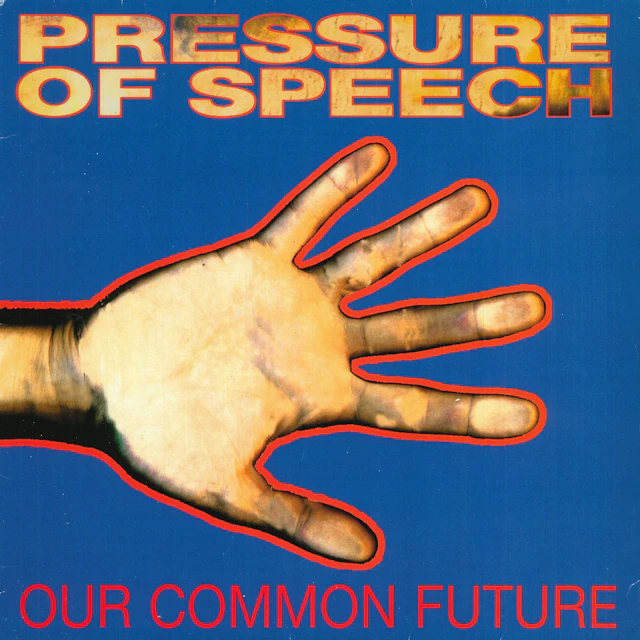
Pressure of Speech - Our Common Past, Our Common Future
Krisis Publishing
- 1 Backfed
- 2Tippex Reality
- 31st Hand
- 4The Kelpie Domain
- 5Uluru
- 6Crow Road
- 7Mothmath
- 8Madam Moth
036
•
Open edition
Founded in 1993 by Mickey Mann (a legendary sound engineer from the era of Orbital, System 7, and Meat Beat Manifesto) together with fellow explorers Luke Losey (lighting designer for Orbital) and DJ Stika (Spiral Tribe), Pressure of Speech remains one of the best-kept secrets of 1990s British electronica. Their elusive second album, Our Common Past, Our Common Future, is wired, political, and born from the squat culture and illegal raves that shaped London’s underground at the time.
Mickey’s background as a psychiatric nurse fed directly into the project’s raw emotional charge – the name itself comes from a clinical term for manic, unstoppable speech. It’s a fitting, if hyperbolic, metaphor for the album’s dense torrent of sonic information: “an anti-manifesto for modern living.” Originally issued in 1996 by North South as the follow-up to their acclaimed debut Art of the State and the Assume Nothing EP, Our Common Past, Our Common Future amplifies the dark, psychedelic technoid textures of its predecessor but takes them to a further degree of abstraction and displacement. Grounded in conflict and material reality, its imaginative reach sketches pathways beyond the suffocating circuitry of the entertainment industry.
Across eight tracks, notions of time, space, and social order are deconstructed through hypnotic synth lines, repetitive techno (1st Hand) and mutant breakbeat (Crow Road) structures interwoven with fragments of everyday life—field recordings, children's laughter, distant explosions (Uluru, Backfed). In Tippex Reality, the flare of a matchstick illuminates half-erased voices from the future with found-sound drums prescient of Burial; meanwhile, a fascination with insects, ultrasounds, surveillance technology, and ancient myths infuses the more ethereal The Kelpie Domain and the closing two-part suite Mothmath / Madame Moth.
The band’s own words capture the spirit and intent behind the album: “Funny reviews — always wanting to make us a dance band… We always considered Pressure of Speech to be folk music: protest songs and stories about the land. We’re more relevant now than we were then, given the politics of the world... In the mid-’90s everybody was on happy pills except me and Mickey! We were always more into mind expansion than E or that nasty McDonald’s-style sniff stuff that kills people and ideas. There’s a great quote that says we’re ‘more Karl Marx than Carl Cox’ — very funny, and very true.”
Mickey’s background as a psychiatric nurse fed directly into the project’s raw emotional charge – the name itself comes from a clinical term for manic, unstoppable speech. It’s a fitting, if hyperbolic, metaphor for the album’s dense torrent of sonic information: “an anti-manifesto for modern living.” Originally issued in 1996 by North South as the follow-up to their acclaimed debut Art of the State and the Assume Nothing EP, Our Common Past, Our Common Future amplifies the dark, psychedelic technoid textures of its predecessor but takes them to a further degree of abstraction and displacement. Grounded in conflict and material reality, its imaginative reach sketches pathways beyond the suffocating circuitry of the entertainment industry.
Across eight tracks, notions of time, space, and social order are deconstructed through hypnotic synth lines, repetitive techno (1st Hand) and mutant breakbeat (Crow Road) structures interwoven with fragments of everyday life—field recordings, children's laughter, distant explosions (Uluru, Backfed). In Tippex Reality, the flare of a matchstick illuminates half-erased voices from the future with found-sound drums prescient of Burial; meanwhile, a fascination with insects, ultrasounds, surveillance technology, and ancient myths infuses the more ethereal The Kelpie Domain and the closing two-part suite Mothmath / Madame Moth.
The band’s own words capture the spirit and intent behind the album: “Funny reviews — always wanting to make us a dance band… We always considered Pressure of Speech to be folk music: protest songs and stories about the land. We’re more relevant now than we were then, given the politics of the world... In the mid-’90s everybody was on happy pills except me and Mickey! We were always more into mind expansion than E or that nasty McDonald’s-style sniff stuff that kills people and ideas. There’s a great quote that says we’re ‘more Karl Marx than Carl Cox’ — very funny, and very true.”