

- 1Murphy's 11th Law
- 2Ode
- 3Gravel
- 4Trilemma
- 5Foreword
- 6Pastor
- 7Free Wheel
- 8Overpass
- 9Uncertainty Principle
- 10Provenience
- 11Curious and Inhuman
- 12Matter Antimatter
- 13Nadir
TT559-113
•
Edition of 200
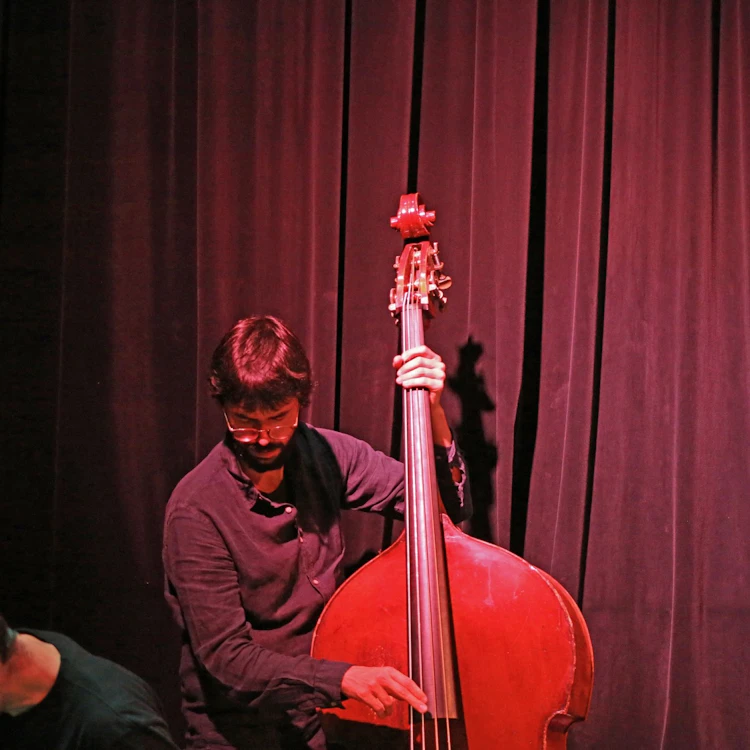
ORÈ is an Amsterdam-based quartet that blends free jazz, contemporary and Brazilian music. The name, meaning “us” or “our” in the Tupi-Guarani language, reflects the group’s collective spirit, emphasising spontaneity and trust.
Their music flows between structure and freedom, guided by lyricism, groove, and textural exploration. Compositions are treated less as fixed forms and more as open frameworks—spaces where improvisation can unfold organically. Rhythmic ideas rooted in Afro-Brazilian and Indigenous traditions often inform the music, not precisely as stylistic references, but mostly as underlying inspirations.
ORÈ’s aesthetic resists easy classification. It is raw and melodic, experimental yet grounded, with an emphasis on interplay. Their music is influenced by artists like Henry Threadgill, Brazilian modernists composers such as Osvaldo Lacerda and Cláudio Santoro, as well as the rhythmical tradition of Brazil.
Rather than fusing genres, ORÈ explores how contrasting musical languages can coexist, clash, and evolve within a single piece. This tension between clarity and abstraction, form and formlessness, is central to their work.
Their music flows between structure and freedom, guided by lyricism, groove, and textural exploration. Compositions are treated less as fixed forms and more as open frameworks—spaces where improvisation can unfold organically. Rhythmic ideas rooted in Afro-Brazilian and Indigenous traditions often inform the music, not precisely as stylistic references, but mostly as underlying inspirations.
ORÈ’s aesthetic resists easy classification. It is raw and melodic, experimental yet grounded, with an emphasis on interplay. Their music is influenced by artists like Henry Threadgill, Brazilian modernists composers such as Osvaldo Lacerda and Cláudio Santoro, as well as the rhythmical tradition of Brazil.
Rather than fusing genres, ORÈ explores how contrasting musical languages can coexist, clash, and evolve within a single piece. This tension between clarity and abstraction, form and formlessness, is central to their work.





![BABY ROCKET - WHAT'S UP (WITH ANGEL RIDER) [TAUBEXOXO4]](https://nina.imgix.net/https%3A%2F%2Fgateway.irys.xyz%2FQb2fgvjABcPq4SYzVApg9Ik9Hm_f6XA8lVDWpJpIbkg?ixlib=js-3.8.0&w=2048&fm=webp&s=499c720bd385bef358d21a4e036cd510)

