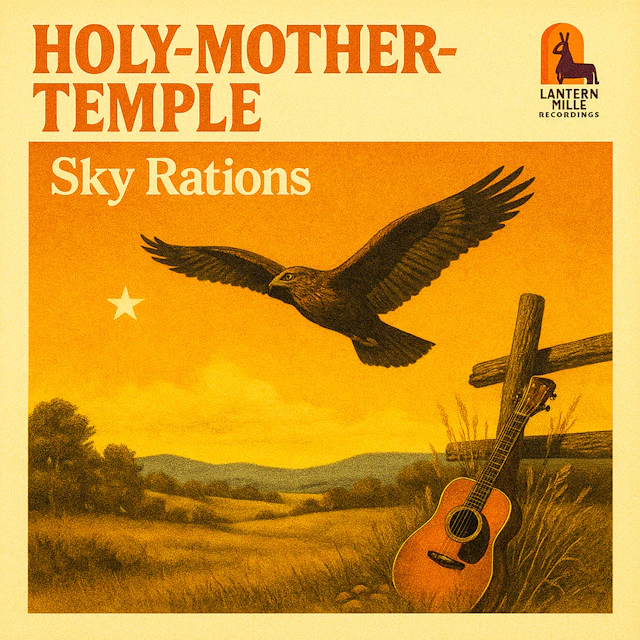
LMR-001: HOLY-MOTHER-TEMPLE - Sky Rations

- 1Juniper Telegraph
- 2Mule-Light Waltz
- 3Dry County Halo
- 4Salt Flat Radio
- 5Cinder House Farewell
- 6Sky Rations (Long Cut)
- 7Heat Map Hymns
- 8Weather As Engine
- 9Generator Drift (Cinder House Closing Pass)
LMR-001
•
Open edition
LMR-001: HOLY-MOTHER-TEMPLE – Sky Rations
Label: Lantern Mule Recordings
Format: 2×Cassette (2×CS; Type I Ferric; real-time duplication)
Recording Year: 1972–1973
Release Year: 1973
Edition: ~65 copies (2×CS primary run); ~35 copies (single-CS abridged variant)
Location: “Cinder House,” converted pump-house cabin outside Truth or Consequences, New Mexico
Total Runtime: ~83:00 (full 2×CS program)
SIGNAL PRESSURE REVIEW
Sky Rations took its final shape on cassette, not vinyl.
The material was recorded between late 1972 and early 1973 at the Cinder House, where HOLY-MOTHER-TEMPLE worked without a fixed album plan and without reliable power. What they did have was time and space. Songs grew long, settled into repeatable forms, and stayed that way. When duplication became necessary, cassette was the obvious choice. It was cheaper, easier to move, and better suited to the small touring loop that sustained Lantern Mule’s early economics.
The double-cassette format wasn’t a statement. It was a solution. Cutting the material down would have meant changing how the band actually played. Instead, they kept parallel passes and extended sections intact. Nothing here is framed as extra material. These tracks functioned the same way in rehearsal and on tape.
Musically, the record is patient by design. Bass and drums maintain steady patterns with little advance signaling. Guitars move laterally rather than upward—pedal steel bending against plain electric figures, fuzz introduced without emphasis and left in place. Vocals sit inside the arrangements, acting as internal markers rather than leads.
The krautrock influence shows up in method, not surface detail. Repetition is trusted. Time flattens drama instead of building it. At the same time, the songs never stop being songs. Choruses return, progressions resolve, and the country-folk frame remains clear throughout.
The later LP edition extracted one workable sequence from this larger body of material. The 2×CS remains the primary document. It reflects how the band worked, how the music moved, and how Lantern Mule operated in practice.
TECHNICAL INFORMATION & RECORDING SPECIFICATIONS
• Recorded live to ¼″ stereo tape on Revox A77 (7.5 IPS)
• Minimal overdubs via second-deck bounce
• No compression or equalization applied during tracking
• Microphones:
• Shure 545 — vocals / amp blend
• AKG D19 — room capture
• Homemade contact microphone — kick beater board (selected takes)
• Monitoring via small PA head and passive cabinets
• Power supplied by cabin mains; RV generator used for evening sessions
• Cassette masters assembled directly from session reels; no remix stage
• Real-time duplication; no noise reduction applied
TRACKLIST + CUE LOG
Cassette 1 – Heat Map Hymns / Primary Passes (~35:50)
Side A
1․ Juniper Telegraph – 08:23
2․ Mule-Light Waltz – 07:59
Side B
3․ Dry County Halo – 07:28
4․ Salt Flat Radio – 07:37
5․ Cinder House Farewell – 09:22
Cassette 2 – Extended & Companion Passes (~47:10)
Side C
6․ Sky Rations (Long Cut) – 09:27
7․ Heat Map Hymns – 11:59
Side D
8․ Weather As Engine – 09:47
9․ Generator Drift (Cinder House Closing Pass) – 12:18
Total Runtime: ~83:00
INSERTS & VISUAL EPHEMERA
• Folded J-card with track listing and credits (typewritten, photocopied)
• Hand-drawn route sketch to “Cinder House” included in some early copies
• Rubber-stamped cassette shells: “HMT – keep moving” (multiple stamp variations)
PHYSICAL RELEASE DETAILS
• Shells: clear or smoke grey (supply-dependent)
• Duplication: real-time, home decks
• Labels: typed or stamped; no two runs identical
• Packaging assembled by band and associates
• Single-CS abridged version omits Cassette 2 material
SUBSEQUENT FORMATS & VARIANTS
• Single-CS abridged version issued concurrently in smaller quantity
• LP edition derived later from Cassette 1 program only
• No authorized reissues
• No centralized master archive confirmed
EPILOGUE
As a double cassette, Sky Rations fit its conditions. It traveled easily, sold directly, and didn’t ask the music to change shape. The added closing pass on Side D wasn’t about completion or atmosphere; it was about leaving the work intact and letting the tape run until the side was full. The LP that followed was a practical extract. The cassette remains the closest record of how the band actually operated.
FOR LISTENERS OF:
• Neil Young – On the Beach
• Grateful Dead – early ’70s longform live material
• Ash Ra Tempel – Ash Ra Tempel
• Merle Haggard – early Capitol sides
• Popol Vuh – early electric recordings
credits
released January 1, 1973
• Mara “Mare” Kincaid — vocals, rhythm guitar, pump organ
• Rowan Doss — vocals, electric guitar, pedal steel, fuzz / phase switching
• Cal Rooker — vocals, bass guitar, tambourine
• Jed “Rim” Lattimer — drums, floor-tom emphasis, hand percussion
license
all rights reserved
Label: Lantern Mule Recordings
Format: 2×Cassette (2×CS; Type I Ferric; real-time duplication)
Recording Year: 1972–1973
Release Year: 1973
Edition: ~65 copies (2×CS primary run); ~35 copies (single-CS abridged variant)
Location: “Cinder House,” converted pump-house cabin outside Truth or Consequences, New Mexico
Total Runtime: ~83:00 (full 2×CS program)
SIGNAL PRESSURE REVIEW
Sky Rations took its final shape on cassette, not vinyl.
The material was recorded between late 1972 and early 1973 at the Cinder House, where HOLY-MOTHER-TEMPLE worked without a fixed album plan and without reliable power. What they did have was time and space. Songs grew long, settled into repeatable forms, and stayed that way. When duplication became necessary, cassette was the obvious choice. It was cheaper, easier to move, and better suited to the small touring loop that sustained Lantern Mule’s early economics.
The double-cassette format wasn’t a statement. It was a solution. Cutting the material down would have meant changing how the band actually played. Instead, they kept parallel passes and extended sections intact. Nothing here is framed as extra material. These tracks functioned the same way in rehearsal and on tape.
Musically, the record is patient by design. Bass and drums maintain steady patterns with little advance signaling. Guitars move laterally rather than upward—pedal steel bending against plain electric figures, fuzz introduced without emphasis and left in place. Vocals sit inside the arrangements, acting as internal markers rather than leads.
The krautrock influence shows up in method, not surface detail. Repetition is trusted. Time flattens drama instead of building it. At the same time, the songs never stop being songs. Choruses return, progressions resolve, and the country-folk frame remains clear throughout.
The later LP edition extracted one workable sequence from this larger body of material. The 2×CS remains the primary document. It reflects how the band worked, how the music moved, and how Lantern Mule operated in practice.
TECHNICAL INFORMATION & RECORDING SPECIFICATIONS
• Recorded live to ¼″ stereo tape on Revox A77 (7.5 IPS)
• Minimal overdubs via second-deck bounce
• No compression or equalization applied during tracking
• Microphones:
• Shure 545 — vocals / amp blend
• AKG D19 — room capture
• Homemade contact microphone — kick beater board (selected takes)
• Monitoring via small PA head and passive cabinets
• Power supplied by cabin mains; RV generator used for evening sessions
• Cassette masters assembled directly from session reels; no remix stage
• Real-time duplication; no noise reduction applied
TRACKLIST + CUE LOG
Cassette 1 – Heat Map Hymns / Primary Passes (~35:50)
Side A
1․ Juniper Telegraph – 08:23
2․ Mule-Light Waltz – 07:59
Side B
3․ Dry County Halo – 07:28
4․ Salt Flat Radio – 07:37
5․ Cinder House Farewell – 09:22
Cassette 2 – Extended & Companion Passes (~47:10)
Side C
6․ Sky Rations (Long Cut) – 09:27
7․ Heat Map Hymns – 11:59
Side D
8․ Weather As Engine – 09:47
9․ Generator Drift (Cinder House Closing Pass) – 12:18
Total Runtime: ~83:00
INSERTS & VISUAL EPHEMERA
• Folded J-card with track listing and credits (typewritten, photocopied)
• Hand-drawn route sketch to “Cinder House” included in some early copies
• Rubber-stamped cassette shells: “HMT – keep moving” (multiple stamp variations)
PHYSICAL RELEASE DETAILS
• Shells: clear or smoke grey (supply-dependent)
• Duplication: real-time, home decks
• Labels: typed or stamped; no two runs identical
• Packaging assembled by band and associates
• Single-CS abridged version omits Cassette 2 material
SUBSEQUENT FORMATS & VARIANTS
• Single-CS abridged version issued concurrently in smaller quantity
• LP edition derived later from Cassette 1 program only
• No authorized reissues
• No centralized master archive confirmed
EPILOGUE
As a double cassette, Sky Rations fit its conditions. It traveled easily, sold directly, and didn’t ask the music to change shape. The added closing pass on Side D wasn’t about completion or atmosphere; it was about leaving the work intact and letting the tape run until the side was full. The LP that followed was a practical extract. The cassette remains the closest record of how the band actually operated.
FOR LISTENERS OF:
• Neil Young – On the Beach
• Grateful Dead – early ’70s longform live material
• Ash Ra Tempel – Ash Ra Tempel
• Merle Haggard – early Capitol sides
• Popol Vuh – early electric recordings
credits
released January 1, 1973
• Mara “Mare” Kincaid — vocals, rhythm guitar, pump organ
• Rowan Doss — vocals, electric guitar, pedal steel, fuzz / phase switching
• Cal Rooker — vocals, bass guitar, tambourine
• Jed “Rim” Lattimer — drums, floor-tom emphasis, hand percussion
license
all rights reserved