Marnie Weber - Returning Home: The Music of Marnie Weber
Phantom Limb
- 1Tiger, Tiger
- 2Nude in Solitude
- 3Songs Hurt Me
- 4The Ship Song
- 5Moans
- 6The Passionate One
- 7Shanghai My Heart
- 8In The Meadow
SUNLANG010
•
Open edition
"Transgressive femininity and storybook creepiness...straddles the fine line between sweetly affecting and genuinely terrifying... Potent." - The Wire
"Unsettling minimalism... with pagan intensity and disturbing sound design." - Uncut Magazine
The storied, three-decade (and counting) career of American visual and performance artist, sculptor, photographer, filmmaker, costume designer, and musician Marnie Weber (b. 1959) began with gigs paid in beer at an LA trucker bar in 1977. Her band, Party Boys, formed in artists’ hangout spots in downtown LA’s semi-abandoned industrial zones. Weber was then 19 and had just left home. After a handful of shows, the bar’s owner asked if she and her female bandmate would perform nude. Taking this as a sign to leave LA, they promptly took off to London. However, their search for more ethical trade there was arrested by a harrowing experience. The band were violently assaulted following a cancelled gig, resulting in the destruction of their instruments, their singer’s hospitalization, and a night poring over mugshots at Scotland Yard.
On the band’s return to Los Angeles, Weber found that fellow visual artist Marc Kriesel had purchased downtown’s dilapidated American Hotel, and with it the ground floor room Al’s Bar. Weber and her bandmates convinced Kriesel to allow them space to build a stage in the bar, and to book friends and allies to perform while artists and art students could mingle in an accepting environment. In 1989, The Los Angeles Reader described Al’s Bar as “a cross between CBGB’s and Cheers”, and a neon sign above the bar advised its patrons to “Tip or Die." Party Boys performed at Al’s Bar regularly throughout the early 80’s, sharing the stage with generational talents that passed over its beer-drenched floors. L7, Beck, Arto Lindsay, Ry Cooder, The Fall, Fear, Hole, Hüsker Dü, Social Distortion, Nirvana, The Residents, Sonic Youth, Urge Overkill, Jesus Lizard, the Misfits, among plenty more, played to audiences that included Bret Easton Ellis, Steve Buscemi, Tommy Lee, Bill Murray, Al Pacino, Sean Penn, and Chloe Sevigny.
Weber describes the 1987 break-up of Party Boys as “devastating. But had I learned so much from the band that I decided I could start making music on my own.” She began performing alone, booking early shows under her own name with no adornment save for her instrumentation. But, finding the accompanying stage fright overwhelming and distracting, Weber opted to restart, beginning her solo career again in a new guise. In this second iteration, Weber would perform in character, each new composition written as and for a new physical manifestation. “I performed as an old woman, animals, a bunny, a faux pop star, a circus girl, and many more.” As these shows became more elaborate, she remembers having to transport two trucks’ worth of props, sets, and costumes to every performance. “My musicians would have to dress up as monkeys, clowns, aliens, and all kinds of characters. Sometimes the musicianship was compromised by their costumes or fake hands, but I didn’t care.”
In late 1987, now working at Bruce Licher’s legendary Independent Project Records and Press, Weber was persuaded into the recording studio by another UCLA art student, Phil Drucker of LA post-punk acts 17 Pygmies and Savage Republic. Weber remembers "driving down to San Marcos on weekends to work in the studio of a band called White Glove Test.” Drucker steered Weber towards nonconventional song structure and the integration of experimental timbres. With this encouragement, Weber sewed her experience in visual arts and her theatrical characterisations into the strange, compelling, neo-goth art-pop that makes up 1989’s Songs Hurt Me, an astonishingly confident debut record. Its title track - present on this compilation - resembles a kind of kankyō ongaku pop song, its lush and lilting synthesis underpinned by shuddering drum machine static. Track two, “The Passionate One”, is dark and despairing, influences of Einstürzende Neubauten, Jane Austen, Siouxsie Sioux, and Bauhaus all clashing together.
Even as she started, every note, every lyric, of Weber’s music felt bound into a dense and deeply structured narrative universe. Characters, actions, geographies, environments, and moods feel as tangible as our own world. Around this time, Weber also began experimenting in film, initially as a backdrop to her live performances, and eventually into writing and producing feature length works, for which she composes every score. This marriage of distinct but demanding artforms is part of what makes the creative work we now present so personal and so emotionally expressive.
Next came 1991’s Woman With Bass album, on which “Tiger, Tiger” and “Nude in Solitude” from our compilation originated. Weber’s songwriting had become stronger still, keenly feminist, its imagery bolder and sharper. “Tiger, Tiger” was written in Weber’s “Coquette” character, a circus girl “of childlike innocence, who came to Los Angeles with dreams of stardom but fell into a dark circus life.”
In the mid 90’s came a turning point. Sonic Youth’s Kim Gordon and Thurston Moore attended a New York exhibition of Weber’s visual work. Introduced through a mutual friend - the late artist Mike Kelley - Gordon and Moore fell in love with Weber’s work, and a new kinship was born. Weber’s 1996 album Cry For Happy (represented here in “Moans” and “In The Meadow”) was released on Thurston Moore’s Ecstatic Peace! label and shot Weber into the awareness of not only Sonic Youth fans, but also the wider ecosystem offered by a label with significant backing. Becoming yet more closely creatively aligned, Sonic Youth invited Weber to create the artwork to their next album, 1998’s A Thousand Leaves. The photo they settled on was taken in Tokyo in 1969, shortly after Weber’s family had moved to Taipei for her father’s work. In the cover art, a 10-year old Marnie is seen modelling duvet covers for a Japanese mattress firm, wearing a strangely haunted expression and newly added guinea pig ears. Weber’s relationship with Sonic Youth confirmed what her fanbase already knew: Weber was already capable of marrying beguiling and instantaneous songcraft with dissonance and exploratory sonics, and now the torchbearers of that school had taken notice.
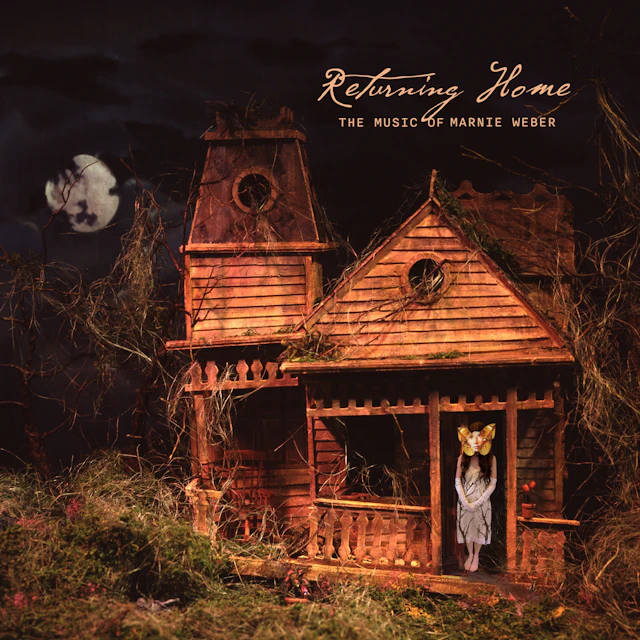
Returning Home is a collection of material from that era, a gateway into those fully formed imaginary worlds conjured from instrumentation and voice by Marnie Weber. It follows the early performative works, the formation of Weber’s conceptual art band The Spirit Girls, and the decades of worldwide exhibition of Weber’s visual art, film works, installations, and countless more stories to add to an already eclectic tome. “Together with my history in performance, this record has a very unique resonance,” Weber writes. She is right.
"Unsettling minimalism... with pagan intensity and disturbing sound design." - Uncut Magazine
The storied, three-decade (and counting) career of American visual and performance artist, sculptor, photographer, filmmaker, costume designer, and musician Marnie Weber (b. 1959) began with gigs paid in beer at an LA trucker bar in 1977. Her band, Party Boys, formed in artists’ hangout spots in downtown LA’s semi-abandoned industrial zones. Weber was then 19 and had just left home. After a handful of shows, the bar’s owner asked if she and her female bandmate would perform nude. Taking this as a sign to leave LA, they promptly took off to London. However, their search for more ethical trade there was arrested by a harrowing experience. The band were violently assaulted following a cancelled gig, resulting in the destruction of their instruments, their singer’s hospitalization, and a night poring over mugshots at Scotland Yard.
On the band’s return to Los Angeles, Weber found that fellow visual artist Marc Kriesel had purchased downtown’s dilapidated American Hotel, and with it the ground floor room Al’s Bar. Weber and her bandmates convinced Kriesel to allow them space to build a stage in the bar, and to book friends and allies to perform while artists and art students could mingle in an accepting environment. In 1989, The Los Angeles Reader described Al’s Bar as “a cross between CBGB’s and Cheers”, and a neon sign above the bar advised its patrons to “Tip or Die." Party Boys performed at Al’s Bar regularly throughout the early 80’s, sharing the stage with generational talents that passed over its beer-drenched floors. L7, Beck, Arto Lindsay, Ry Cooder, The Fall, Fear, Hole, Hüsker Dü, Social Distortion, Nirvana, The Residents, Sonic Youth, Urge Overkill, Jesus Lizard, the Misfits, among plenty more, played to audiences that included Bret Easton Ellis, Steve Buscemi, Tommy Lee, Bill Murray, Al Pacino, Sean Penn, and Chloe Sevigny.
Weber describes the 1987 break-up of Party Boys as “devastating. But had I learned so much from the band that I decided I could start making music on my own.” She began performing alone, booking early shows under her own name with no adornment save for her instrumentation. But, finding the accompanying stage fright overwhelming and distracting, Weber opted to restart, beginning her solo career again in a new guise. In this second iteration, Weber would perform in character, each new composition written as and for a new physical manifestation. “I performed as an old woman, animals, a bunny, a faux pop star, a circus girl, and many more.” As these shows became more elaborate, she remembers having to transport two trucks’ worth of props, sets, and costumes to every performance. “My musicians would have to dress up as monkeys, clowns, aliens, and all kinds of characters. Sometimes the musicianship was compromised by their costumes or fake hands, but I didn’t care.”
In late 1987, now working at Bruce Licher’s legendary Independent Project Records and Press, Weber was persuaded into the recording studio by another UCLA art student, Phil Drucker of LA post-punk acts 17 Pygmies and Savage Republic. Weber remembers "driving down to San Marcos on weekends to work in the studio of a band called White Glove Test.” Drucker steered Weber towards nonconventional song structure and the integration of experimental timbres. With this encouragement, Weber sewed her experience in visual arts and her theatrical characterisations into the strange, compelling, neo-goth art-pop that makes up 1989’s Songs Hurt Me, an astonishingly confident debut record. Its title track - present on this compilation - resembles a kind of kankyō ongaku pop song, its lush and lilting synthesis underpinned by shuddering drum machine static. Track two, “The Passionate One”, is dark and despairing, influences of Einstürzende Neubauten, Jane Austen, Siouxsie Sioux, and Bauhaus all clashing together.
Even as she started, every note, every lyric, of Weber’s music felt bound into a dense and deeply structured narrative universe. Characters, actions, geographies, environments, and moods feel as tangible as our own world. Around this time, Weber also began experimenting in film, initially as a backdrop to her live performances, and eventually into writing and producing feature length works, for which she composes every score. This marriage of distinct but demanding artforms is part of what makes the creative work we now present so personal and so emotionally expressive.
Next came 1991’s Woman With Bass album, on which “Tiger, Tiger” and “Nude in Solitude” from our compilation originated. Weber’s songwriting had become stronger still, keenly feminist, its imagery bolder and sharper. “Tiger, Tiger” was written in Weber’s “Coquette” character, a circus girl “of childlike innocence, who came to Los Angeles with dreams of stardom but fell into a dark circus life.”
In the mid 90’s came a turning point. Sonic Youth’s Kim Gordon and Thurston Moore attended a New York exhibition of Weber’s visual work. Introduced through a mutual friend - the late artist Mike Kelley - Gordon and Moore fell in love with Weber’s work, and a new kinship was born. Weber’s 1996 album Cry For Happy (represented here in “Moans” and “In The Meadow”) was released on Thurston Moore’s Ecstatic Peace! label and shot Weber into the awareness of not only Sonic Youth fans, but also the wider ecosystem offered by a label with significant backing. Becoming yet more closely creatively aligned, Sonic Youth invited Weber to create the artwork to their next album, 1998’s A Thousand Leaves. The photo they settled on was taken in Tokyo in 1969, shortly after Weber’s family had moved to Taipei for her father’s work. In the cover art, a 10-year old Marnie is seen modelling duvet covers for a Japanese mattress firm, wearing a strangely haunted expression and newly added guinea pig ears. Weber’s relationship with Sonic Youth confirmed what her fanbase already knew: Weber was already capable of marrying beguiling and instantaneous songcraft with dissonance and exploratory sonics, and now the torchbearers of that school had taken notice.
Returning Home is a collection of material from that era, a gateway into those fully formed imaginary worlds conjured from instrumentation and voice by Marnie Weber. It follows the early performative works, the formation of Weber’s conceptual art band The Spirit Girls, and the decades of worldwide exhibition of Weber’s visual art, film works, installations, and countless more stories to add to an already eclectic tome. “Together with my history in performance, this record has a very unique resonance,” Weber writes. She is right.