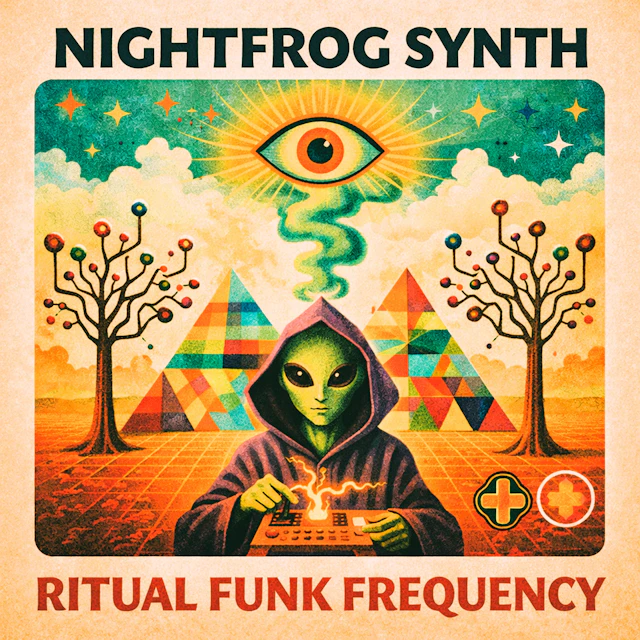
AWR2-001: NIGHTFROG SYNTH – Ritual Funk Frequency
Aurora Weltklang Remnants 2.0
- 1Frequency Held Open
- 2Funk Unit Refuses Correction
- 3Pulse Without Ornament
- 4End Pattern, No Signal Down
AWR2-001
•
Open edition
AWR2-001: NIGHTFROG SYNTH – Ritual Funk Frequency
Format: Digital-Only Album (Lossless FLAC, archival circulation)
Label: Aurora Weltklang — Remnants 2.0
Recording Year: 1979
Release Year: 1979 (Recovered / Issued 2026)
Edition: Digital circulation only (no public physical issue)
Location: Cologne (DE)
Total Runtime: 47:18
Genres: Proto-Industrial Dance · Occult Synth-Funk · Minimal Body Music · Machine Groove · Underground Club Electronics
SIGNAL PRESSURE REVIEW
NIGHTFROG SYNTH did not make songs. They built a room that refused to cool down.
Ritual Funk Frequency is Cologne after midnight: lights half-dead, power unstable, bodies moving because stopping feels worse. Drum machines lock into blunt, joyless patterns. Synth lines repeat until they lose identity and become surface tension. Bass stays low and steady, less groove than ballast—keeping the structure from tipping over while everything else strains.
This is dance music stripped of release. No breakdowns. No lift. No chorus waiting at the end. Movement is mandatory, not celebratory. When the tracks feel loose, it’s because components are warming, clocks are bleeding, voltage is sagging. Nothing is “performed” for expression. Everything happens because the system keeps running.
There’s an occult pull here, but not mysticism—mechanical inevitability. The patterns don’t summon; they persist. The floor doesn’t erupt; it endures. Sweat, repetition, pressure. When the tape ends, it’s not resolution—it’s shutdown.
Preserved under Remnants 2.0 exactly as found. No fixes. No smoothing. No apology.
TECHNICAL INFORMATION & RECORDING SPECIFICATIONS
• Primary Hardware:
• Concord Electronics modular sequencing rack (discrete logic; no recall memory)
• Nordkreis Instruments voltage-controlled oscillators and clock dividers (intentionally unstable)
• Rhythm System:
• Modified Ace Tone FR-3 analog rhythm unit
• Pattern gating routed through Concord step logic for hard lock / soft drift behavior
• Synth & Control Sources:
• ARP Odyssey (CV driven by Nordkreis clock bleed)
• Korg MS-20 (external signal processor looped for feedback coloration)
• Bass Chain:
• Electric bass → Concord envelope follower → direct inject
• Single room microphone on cabinet to capture floor interaction
• Signal Path:
• Direct outputs summed with minimal bus routing
• No corrective EQ, no compression stages during capture
• Recording Method:
• Live room performance captured to reel
• Parallel sequence bounce used only to bridge reel changes
• Editing & Transfer:
• Track boundaries preserved exactly as performed
• 24-bit / 96 kHz archival transfer from aligned reel sources
• No internal edits, no reconstruction
• Condition Notes:
• Timing drift caused by clock bleed and oscillator temperature rise
• Minor voltage sag audible during sustained passages
• All behavior retained as recorded
TRACKLIST + CUE LOG
1․ Frequency Held Open – 11:52
2․ Funk Unit Refuses Correction – 11:49
3․ Pulse Without Ornament – 12:03
4․ End Pattern, No Signal Down – 11:34
Total Runtime: 47:18
INSERTS & VISUAL EPHEMERA
• Digital cover bearing Remnants 2.0 grid mark
• Minimal metadata sheet (artist, year, location)
• No diagrams, schematics, or interpretive notes
PHYSICAL SOURCE MATERIAL
• ¼-inch reel stored in climate-controlled archive
• C60 ferric cassette retained as safety/reference
SUBSEQUENT FORMATS & VARIANTS
• Exists exclusively within Aurora Weltklang — Remnants 2.0 digital archive
• No alternate mixes, edits, or remasters authorized
• Occasionally misidentified externally as “early electro demo” due to lack of polish
EPILOGUE
NIGHTFROG SYNTH didn’t refine the machine. They stayed inside it until attention stopped paying interest.
Ritual Funk Frequency survives because it captures a state: bodies moving under pressure, circuits holding just long enough, rhythm as obligation. The tape didn’t ask to be improved. It asked to be left alone.
FOR LISTENERS OF:
• DAF — early mechanical body music
• Liaisons Dangereuses — club pressure minimalism
• Cabaret Voltaire — functional electronics
• Pre-codification European industrial dance scenes
credits
released January 1, 1979
• Ralf Köhler — analog synthesizers (ARP Odyssey, Korg MS-20), step sequencing
• Ingrid Mauer — electric bass, envelope follower, auxiliary percussion
• Thomas Beck — drum machine programming (modified Ace Tone FR-3), live triggers
• Jürgen Weiss — signal routing, distortion units, tape delay, live mix handling
Archival Oversight (Remnants 2.0):
• Loreta Svein — Concord / Nordkreis compliance verification, transfer supervision
all rights reserved
Format: Digital-Only Album (Lossless FLAC, archival circulation)
Label: Aurora Weltklang — Remnants 2.0
Recording Year: 1979
Release Year: 1979 (Recovered / Issued 2026)
Edition: Digital circulation only (no public physical issue)
Location: Cologne (DE)
Total Runtime: 47:18
Genres: Proto-Industrial Dance · Occult Synth-Funk · Minimal Body Music · Machine Groove · Underground Club Electronics
SIGNAL PRESSURE REVIEW
NIGHTFROG SYNTH did not make songs. They built a room that refused to cool down.
Ritual Funk Frequency is Cologne after midnight: lights half-dead, power unstable, bodies moving because stopping feels worse. Drum machines lock into blunt, joyless patterns. Synth lines repeat until they lose identity and become surface tension. Bass stays low and steady, less groove than ballast—keeping the structure from tipping over while everything else strains.
This is dance music stripped of release. No breakdowns. No lift. No chorus waiting at the end. Movement is mandatory, not celebratory. When the tracks feel loose, it’s because components are warming, clocks are bleeding, voltage is sagging. Nothing is “performed” for expression. Everything happens because the system keeps running.
There’s an occult pull here, but not mysticism—mechanical inevitability. The patterns don’t summon; they persist. The floor doesn’t erupt; it endures. Sweat, repetition, pressure. When the tape ends, it’s not resolution—it’s shutdown.
Preserved under Remnants 2.0 exactly as found. No fixes. No smoothing. No apology.
TECHNICAL INFORMATION & RECORDING SPECIFICATIONS
• Primary Hardware:
• Concord Electronics modular sequencing rack (discrete logic; no recall memory)
• Nordkreis Instruments voltage-controlled oscillators and clock dividers (intentionally unstable)
• Rhythm System:
• Modified Ace Tone FR-3 analog rhythm unit
• Pattern gating routed through Concord step logic for hard lock / soft drift behavior
• Synth & Control Sources:
• ARP Odyssey (CV driven by Nordkreis clock bleed)
• Korg MS-20 (external signal processor looped for feedback coloration)
• Bass Chain:
• Electric bass → Concord envelope follower → direct inject
• Single room microphone on cabinet to capture floor interaction
• Signal Path:
• Direct outputs summed with minimal bus routing
• No corrective EQ, no compression stages during capture
• Recording Method:
• Live room performance captured to reel
• Parallel sequence bounce used only to bridge reel changes
• Editing & Transfer:
• Track boundaries preserved exactly as performed
• 24-bit / 96 kHz archival transfer from aligned reel sources
• No internal edits, no reconstruction
• Condition Notes:
• Timing drift caused by clock bleed and oscillator temperature rise
• Minor voltage sag audible during sustained passages
• All behavior retained as recorded
TRACKLIST + CUE LOG
1․ Frequency Held Open – 11:52
2․ Funk Unit Refuses Correction – 11:49
3․ Pulse Without Ornament – 12:03
4․ End Pattern, No Signal Down – 11:34
Total Runtime: 47:18
INSERTS & VISUAL EPHEMERA
• Digital cover bearing Remnants 2.0 grid mark
• Minimal metadata sheet (artist, year, location)
• No diagrams, schematics, or interpretive notes
PHYSICAL SOURCE MATERIAL
• ¼-inch reel stored in climate-controlled archive
• C60 ferric cassette retained as safety/reference
SUBSEQUENT FORMATS & VARIANTS
• Exists exclusively within Aurora Weltklang — Remnants 2.0 digital archive
• No alternate mixes, edits, or remasters authorized
• Occasionally misidentified externally as “early electro demo” due to lack of polish
EPILOGUE
NIGHTFROG SYNTH didn’t refine the machine. They stayed inside it until attention stopped paying interest.
Ritual Funk Frequency survives because it captures a state: bodies moving under pressure, circuits holding just long enough, rhythm as obligation. The tape didn’t ask to be improved. It asked to be left alone.
FOR LISTENERS OF:
• DAF — early mechanical body music
• Liaisons Dangereuses — club pressure minimalism
• Cabaret Voltaire — functional electronics
• Pre-codification European industrial dance scenes
credits
released January 1, 1979
• Ralf Köhler — analog synthesizers (ARP Odyssey, Korg MS-20), step sequencing
• Ingrid Mauer — electric bass, envelope follower, auxiliary percussion
• Thomas Beck — drum machine programming (modified Ace Tone FR-3), live triggers
• Jürgen Weiss — signal routing, distortion units, tape delay, live mix handling
Archival Oversight (Remnants 2.0):
• Loreta Svein — Concord / Nordkreis compliance verification, transfer supervision
all rights reserved